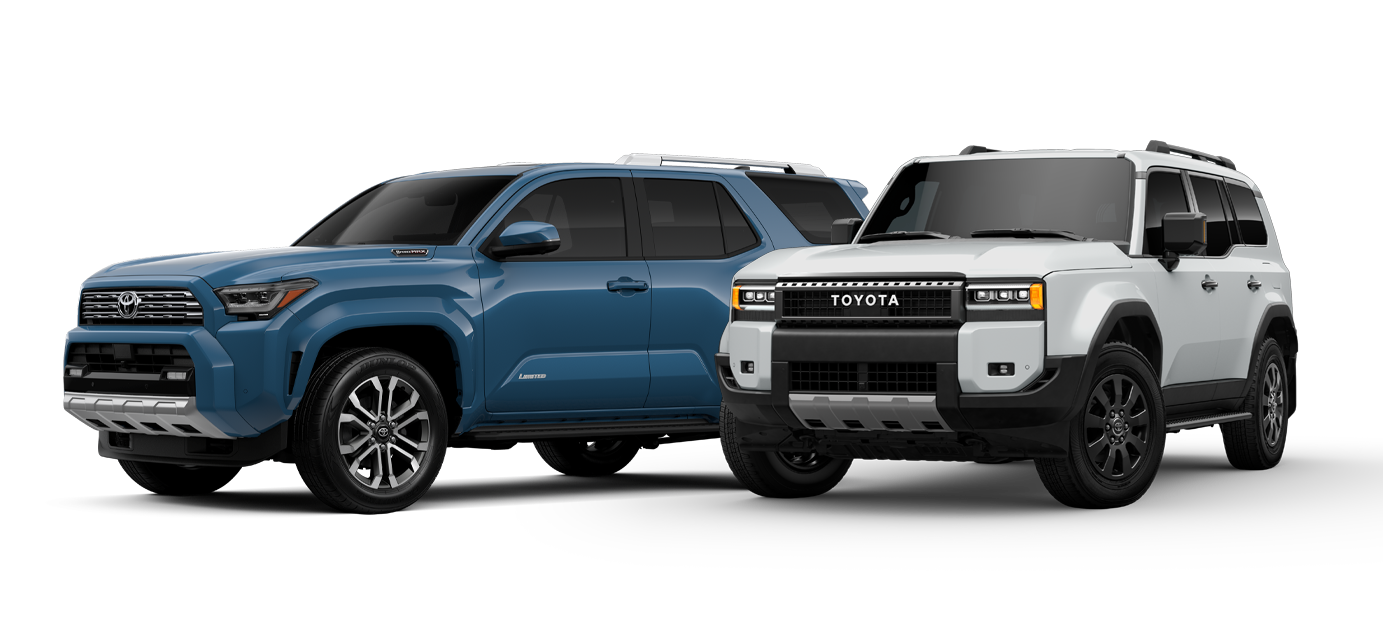
2026 Toyota 4Runner vs. 2026 Toyota Land Cruiser at South Hills Toyota in Canonsburg, PA | Blue 2026 Toyota 4Runner and white 2026 Toyota Land Cruiser

2026 Toyota 4Runner vs. 2026 Toyota Land Cruiser

Toyota builds two body-on-frame midsize SUVs for drivers who want real trail capability alongside everyday comfort: the 2026 Toyota 4Runner and the 2026 Toyota Land Cruiser. Both ride on Toyota’s TNGA-F global truck platform, both offer the i-FORCE MAX hybrid powertrain, and both come standard with Toyota Safety Sense 3.0. Where they differ is in how each one is packaged. The 4Runner offers nine grades, multiple powertrain and drivetrain choices, and available third-row seating, while the Land Cruiser keeps things focused with two grades, one hybrid powertrain, and full-time four-wheel drive on every model. Here is how the two compare, so you can decide which one fits the way you drive.

 
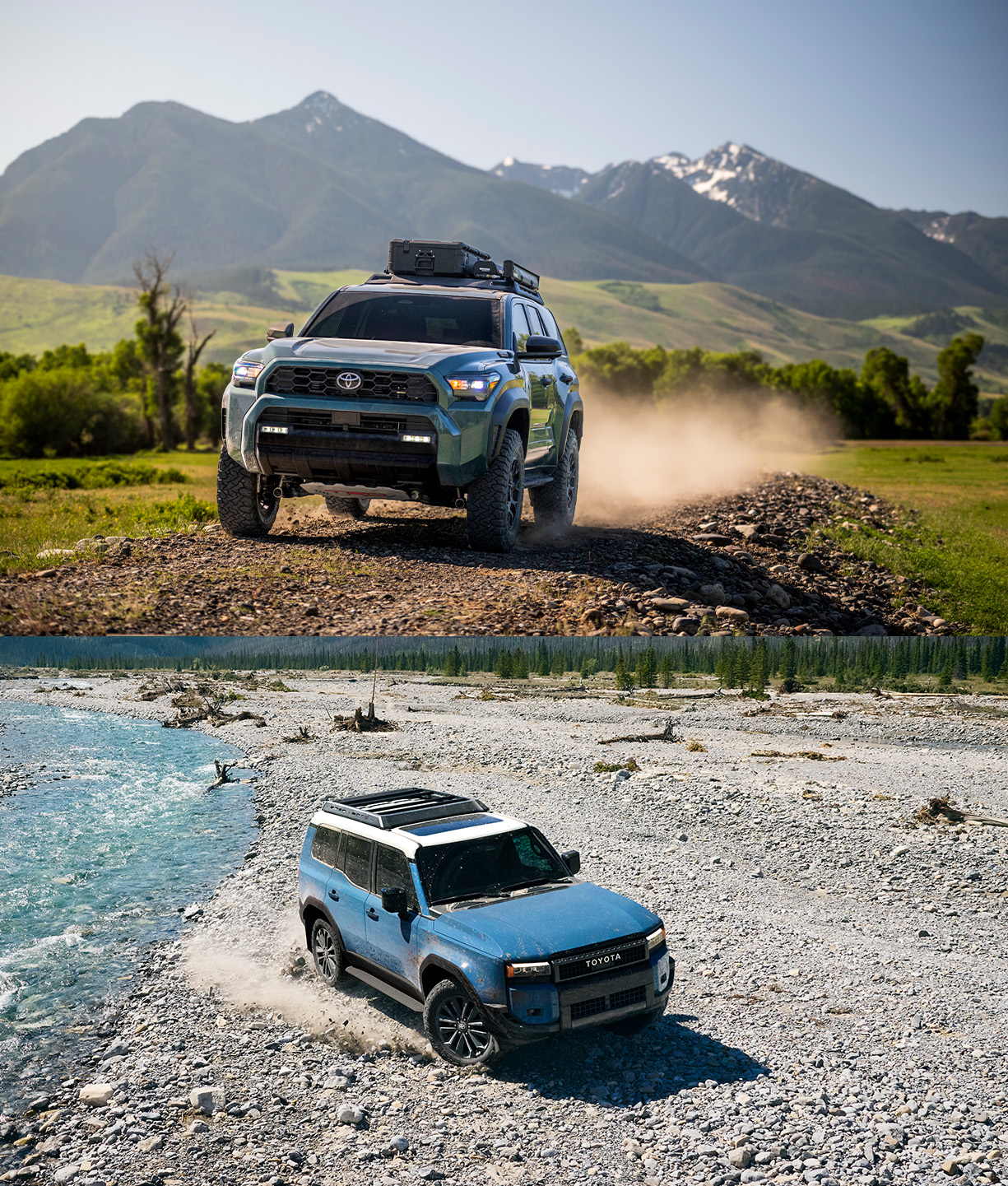
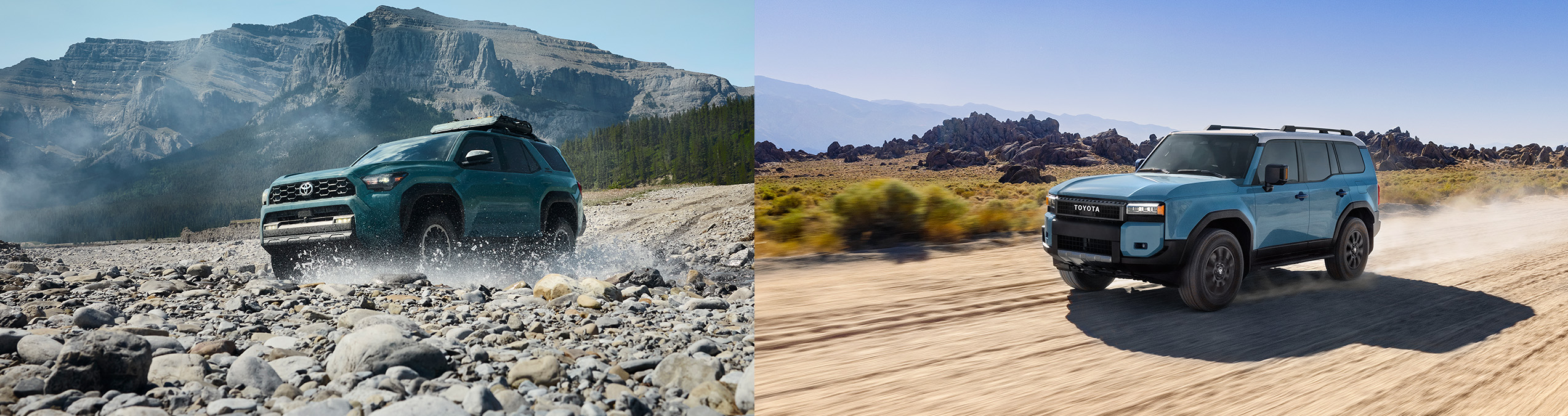
2026 Toyota 4Runner vs. 2026 Toyota Land Cruiser at South Hills Toyota in Canonsburg, PA | 2026 Toyota models, the 4runner and land cruiser, driving off road


Performance

The 2026 4Runner gives buyers two powertrains to choose from. The SR5, TRD Sport, and TRD Sport Premium grades use a 2.4-liter turbocharged i-FORCE engine rated at 278 horsepower and 317 lb-ft of torque, and it is also offered on the TRD Off-Road, TRD Off-Road Premium, and Limited. The i-FORCE MAX hybrid, rated at 326 horsepower and 465 lb-ft of torque, is standard on the TRD Pro, Trailhunter, and Platinum grades and available on the TRD Off-Road, TRD Off-Road Premium, and Limited. EPA-estimated fuel economy is up to 22 MPG combined for i-FORCE models and 23 MPG combined for i-FORCE MAX models. Drivetrain options include two-wheel drive, part-time four-wheel drive, and full-time four-wheel drive with a locking center differential, which is standard on the Platinum and available on i-FORCE MAX Limited models.

Every 2026 Land Cruiser uses the i-FORCE MAX hybrid, producing the same 326 horsepower and 465 lb-ft of torque through an 8-speed automatic transmission. Full-time four-wheel drive is standard on both grades, and the EPA-estimated combined fuel economy is 23 MPG. Both SUVs are rated to tow up to 6,000 pounds.

Off-road hardware is where the two take different paths. The Land Cruiser makes its trail equipment standard across the lineup, including:

  • Locking center and rear differentials on both grades
  • A two-speed transfer case and CRAWL Control
  • A standard trailer brake controller
  • Multi-Terrain Select and Multi-Terrain Monitor on the Land Cruiser grade, which also offers an available front stabilizer bar disconnect

The 4Runner lets drivers choose how much capability they want by grade. Four-wheel-drive models include a two-speed transfer case, Active Traction Control (A-TRAC), and an automatic limited-slip differential. From there, the lineup adds specialized equipment:

  • TRD Off-Road: electronic locking rear differential, Bilstein® remote reservoir shocks, 33-inch all-terrain tires, and Multi-Terrain Select with CRAWL Control
  • TRD Pro: TRD-tuned FOX® QS3 adjustable shocks with rear remote reservoirs, a standard Stabilizer Disconnect Mechanism, and 33-inch Toyo® tires
  • Trailhunter: Old Man Emu® forged monotube shocks, an onboard air compressor, a low-profile high-mount air intake, and a standard Stabilizer Disconnect Mechanism
  • Limited and Platinum: adaptive variable suspension tuned for a smooth on-road ride
 

Design and Comfort

Both SUVs wear boxy, heritage-inspired styling. The Land Cruiser 1958 grade features round LED headlamps and a “TOYOTA” heritage grille, while the Land Cruiser grade uses slim rectangular headlights inspired by the 60 Series, along with RIGID® color-selectable LED fog lights. The 4Runner carries its own heritage cues on select grades, including a “TOYOTA” grille with an integrated LED light bar on the TRD Pro and Trailhunter. Every 4Runner also keeps the signature power rear window in the liftgate, with an available hands-free power liftgate.

Passenger and cargo space is one of the clearest differences between the two. The Land Cruiser seats five across two rows and offers 46.2 cubic feet of cargo space behind the rear seats and 82.1 cubic feet with the rear seats folded. The 4Runner seats five as standard, with an available third row on the SR5 and Limited grades for up to seven passengers. i-FORCE models offer 48.4 cubic feet behind the second row and up to 90.2 cubic feet of maximum cargo volume, while i-FORCE MAX hybrid models give up some cargo room to the hybrid battery.

Interior comfort scales with grade on both models. The Land Cruiser 1958 includes heated fabric front seats, the Land Cruiser grade upgrades to power heated and ventilated SofTex®-trimmed front seats, and the available Premium Package adds leather-trimmed heated and ventilated power front seats with lumbar support and driver memory. On the 4Runner, the TRD Sport Premium and TRD Off-Road Premium add SofTex®-trimmed power seats and a heated steering wheel, the Limited brings heated and ventilated leather-trimmed front seats and a power moonroof, and the Platinum adds premium leather seating with heated second-row outboard seats.


Technology & Safety

Both SUVs run Toyota’s latest Audio Multimedia system with wireless Apple CarPlay® and Android Auto™, a standard Smart Key System with push-button start, and an available Digital Key with an active Remote Connect subscription. Screen sizes and audio vary by grade:

  • 4Runner: an 8-inch touchscreen on the SR5 and TRD Sport, with a 14-inch touchscreen on higher grades. A 12.3-inch digital gauge cluster comes on the TRD Sport and is standard on all i-FORCE MAX models.
  • Land Cruiser: an 8-inch touchscreen, 7-inch gauge cluster, and six-speaker audio on the 1958 grade. The Land Cruiser grade moves up to a 12.3-inch touchscreen, a 12.3-inch digital gauge cluster, 10 speakers, and a Qi-compatible wireless charger.

A 14-speaker JBL® Premium Audio system is available on both. On the 4Runner, it comes on the TRD Sport Premium, TRD Off-Road Premium, Limited, Platinum, TRD Pro, and Trailhunter, paired with a removable JBL® FLEX portable Bluetooth speaker. On the Land Cruiser, it is part of the Premium Package, which also adds a Head-Up Display, digital rearview mirror, and power moonroof. Both offer a 2400-watt AC power supply, standard on every Land Cruiser and on i-FORCE MAX 4Runner models.

Every 2026 4Runner and Land Cruiser comes standard with Toyota Safety Sense™ 3.0, which includes:

  • Pre-Collision System with Pedestrian Detection
  • Lane Departure Alert with Steering Assist
  • Full-Speed Range Dynamic Radar Cruise Control
  • Lane Tracing Assist
  • Road Sign Assist
  • Automatic High Beams
  • Proactive Driving Assist

Blind Spot Monitor is included on both models. For drivers who tow, the 4Runner’s Blind Spot Monitor can extend its detection area to cover a connected trailer, and the 4Runner offers an available Trailer Back-Up Guide with Straight Path Assist. The Land Cruiser includes a trailer brake controller as standard equipment on both grades.

 
Toyota 4Runner and Toyota Land Cruiser

Which One Fits You?

The 2026 4Runner and 2026 Land Cruiser share a platform, a hybrid powertrain option, a 6,000-pound towing rating, and a standard safety suite. The right choice comes down to how you plan to use your SUV.

The 2026 4Runner may be the better fit if you want:

 
  • A wider range of grades, powertrain choices, and available features
  • Available third-row seating for up to seven passengers on the SR5 and Limited
  • Grade-specific off-road hardware, from Bilstein® shocks on the TRD Off-Road to FOX® and Old Man Emu® setups on the TRD Pro and Trailhunter

The 2026 Land Cruiser may be the better fit if you want:

 
  • Hybrid power and full-time four-wheel drive on every model
  • Locking center and rear differentials standard across the lineup
  • A simple two-grade lineup with heritage-inspired design choices

Take both for a drive before you decide. Visit South Hills Toyota in Canonsburg, PA to explore the 2026 Toyota 4Runner and 2026 Toyota Land Cruiser lineups and schedule a test drive of each.